
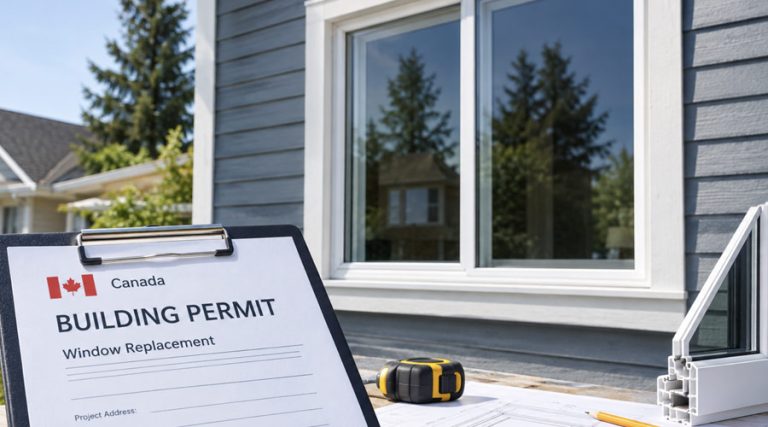
Window Replacement Permit: When You May Need One in Canada
A window replacement permit may be required when the opening, structure, use, appearance or building type changes. Learn what to verify locally before ordering windows or starting work.

Home » Garage Doors Guides » Emergency Guide: How to Open a Garage Door During a Power Outage
Most residential garage doors can open without household power, but the automatic opener must first be disengaged using the model’s emergency release. Work from inside the garage whenever possible, start with the door fully closed, keep the opening clear and use the door’s installed handle or gripping points. If the door is unusually heavy, crooked, damaged or will not stay controlled, stop and call a trained door systems technician.
This guide focuses on an overhead residential door connected to an automatic opener. Wall-mounted openers, one-piece doors, rolling doors, powered locks and exterior release kits can work differently. The current manuals for the exact door and opener take priority over any general sequence.
Do not release an open door. A door with weak or broken springs can fall rapidly after it is disconnected from the opener. If the door is open or partly open when power fails, keep people and vehicles clear and obtain professional help.
The door itself is mechanical. On a properly balanced, undamaged system, it can usually be lifted and lowered by hand after the opener carriage or wall-mounted drive is released. The opener will not run from household electricity during an outage, although a compatible opener with a charged battery backup may continue to operate for a limited period under its own instructions.
A power outage does not bypass a broken spring, jammed track, engaged manual lock or powered door lock. Confirm that the outage is the only apparent issue before trying manual operation. Never increase force, loosen hardware or remove pins to make the door move.
The following sequence applies to many trolley-style residential openers. Release direction and reconnection steps vary, so use the exact manual whenever its instructions differ.
The safest route is another normal entry door that lets you reach the emergency release from inside. If the garage has no secondary entrance, manual access from outside generally depends on a compatible exterior emergency release kit that was installed and tested before the outage.
An exterior release typically uses a keyed lock cylinder and cable to disconnect the opener. It releases the opener only; it does not lift the door or correct a mechanical fault. Follow the kit and opener instructions, then lift the door by its handle only if movement is smooth and controlled.
A door disconnected from its opener may not have the normal resistance or security provided by the connected system. Lower it slowly using the installed handle, keep the path clear and maintain control until it is fully closed. Do not pull on the emergency-release rope to move the door.
Use only the manual lock or securing method provided for the installed door. Record that the lock is engaged: trying to run the opener against a locked door after power returns can damage the door or opener. Do not improvise a brace that could enter the track, damage a panel or be forgotten.
A battery-backup opener may operate during an outage, but available functions and operating time depend on the model, battery condition, temperature and outage duration. Follow the indicator and test procedure in the manual; do not assume the battery is charged because the opener has a backup label.
Wall-mounted or jackshaft openers can include a separate emergency release and automatic door lock. The lock may need its own manual-release step. Do not apply a trolley-opener procedure to a wall-mounted system, and do not force the door if the lock bolt remains engaged.
| Situation | Safe response | Stop and call for service when |
|---|---|---|
| Opener has no power | Confirm the outage and use the model’s manual-release procedure from inside. | The release will not operate or the door does not move freely. |
| Battery backup does not run | Check the manual’s battery status and manual-operation instructions. | There is heat, odour, leakage, damaged wiring or repeated fault indication. |
| Door is already open | Keep the area clear and do not pull the release. | Professional control or temporary securing is needed. |
| Door feels heavy or drops | Stop moving it and keep everyone away. | A spring, cable or balance problem is possible. |
| No alternate entrance | Use only a preinstalled, compatible keyed exterior release. | No approved access method exists or the kit will not release. |
| Power returns while disconnected | Keep controls unused until the door is closed, unlocked and reconnected correctly. | The opener moves unexpectedly or the system will not re-engage. |
Keep the area isolated and contact a trained door systems technician. Call emergency services when there is an immediate risk to people, fire, smoke or another uncontrolled hazard. A heavy, crooked or binding door may have mechanical faults that require repair, even after household power returns.
Emergency-release checks and backup-battery care belong alongside the inspections and service records that form part of regular garage door maintenance.
A power outage normally calls for the opener’s emergency release, not a repair. Start with the door closed, use the exact manual, lift only by an approved handle and stop at the first sign of weight, damage or uncontrolled movement. Plan outside access and battery backup before an outage rather than improvising when the garage is locked.
Continue with Garage Doors 101 or compare qualified professionals who can inspect the complete door and opener system.
Requirements vary by location and project. Confirm current rules with the authority having jurisdiction before ordering, selling or installing products.
No. Many overhead residential doors can be operated manually after the opener is released, but the door must be mechanically sound and properly balanced. Door type, opener design, locks and access arrangements can change the procedure.
It is intended for manual release, but use it only as the exact opener manual directs and preferably with the door fully closed. Never pull it while standing under an open door or use the cord to lift the door.
No. Operation depends on compatibility, battery charge, battery condition, temperature and the outage duration. Check the model’s indicators and manual, and know the manual-release procedure as a fallback.
Use only the door’s provided manual lock or approved securing method. Remember to unlock it before reconnecting and operating the opener. A technician can recommend a compatible security arrangement if the door has no manual lock.
Do not remove pins, disconnect the door arm or reach into the mechanism as a substitute. Keep the door closed and arrange trained service to restore the correct release assembly.
A window replacement permit may be required when the opening, structure, use, appearance or building type changes. Learn what to verify locally before ordering windows or starting work.

A practical framework for generating qualified window and door leads, selecting channels, controlling response and attribution, and avoiding common compliance and quality failures.

A practical framework for moving qualified window and door opportunities through consistent stages, producing evidence-based forecasts and aligning sales activity with operational capacity.

A practical KPI framework for Canadian window and door companies, with controlled definitions, formulas, reporting rules and management actions.