
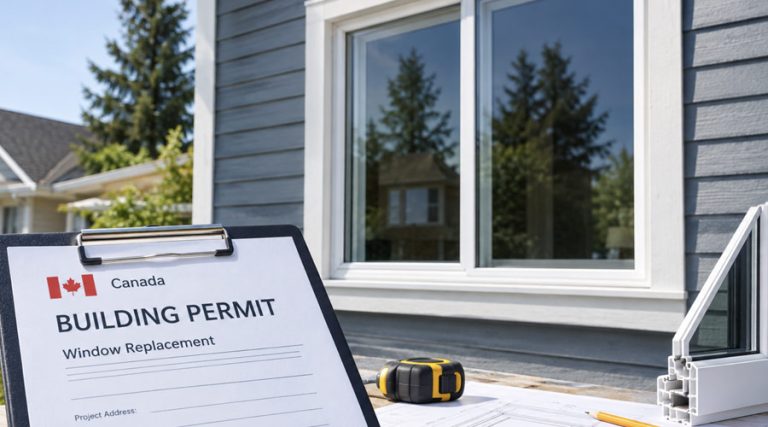
Window Replacement Permit: When You May Need One in Canada
A window replacement permit may be required when the opening, structure, use, appearance or building type changes. Learn what to verify locally before ordering windows or starting work.

Home » Doors Tips » How to Secure Entry Doors in Canadian Homes
When people discuss home security in Canada, the conversation rarely revolves around high-fence perimeters, heavy window bars, or fortress-style fortifications. Canadian residential communities are built on a different framework entirely one shaped by open suburban layouts, shared neighborhood initiatives, and a baseline of social trust. It is entirely normal to leave front windows unobstructed or greet neighbors across low property lines without a second thought.
Yet, relying solely on community safety or a neighborhood’s low crime rate overlooks the physical reality of homeownership. True, long-term peace of mind requires a balance between a secure environment and tangible, physical preparedness. And that physical defense always starts at the exact same point: the primary threshold of the house. Long before a door faces any kind of external pressure, it undergoes a daily, relentless test from an entirely different source: the local environment, extreme seasonal thermal shifts, and natural structural aging.
Key Buying Question
While Canadian neighborhoods generally rely on a strong foundation of community trust and standard suburban builds, physical safety starts at the threshold. Homeowners must look beyond basic neighborhood safety and evaluate how well their primary entryways withstand both environmental wear and physical intrusion.
Simple takeaway: Securing a Canadian home begins at the front door, where local climate stress and physical hardware intersect.
When discussing the integrity of an exterior door, most homeowners immediately think about hardware strength or deadbolt ratings. However, in the Canadian context, the most persistent force acting against your entryway isn’t human it is the environment.
Canada’s climate is defined by extreme, cyclical environmental stress. From humid summers with heavy precipitation to sub-zero winter deep freezes, exterior building materials undergo continuous expansion and contraction. This relentless thermal cycling affects every component of an entryway system:
Thermal Expansion and Wood Movement: Traditional framing lumber and wood components absorb moisture during wet autumn and spring months. When temperatures plummet, that moisture freezes, causing wood fibers to swell, warp, and shift. Over multiple seasons, this creates permanent micro-distortions in the door frame.
Seal and Weatherstripping Degradation: Extreme cold makes standard rubber and vinyl weatherstripping brittle, causing it to lose its elasticity and crack. When seals fail, drafts infiltrate the home, but more importantly, microscopic gaps form around the perimeter, disrupting the flush alignment between the door slab and its frame.
Hardware Misalignment: As the surrounding wall structure and wooden jambs shift under thermal stress, the strike plate and latch bolt drift out of alignment. A door that latches smoothly in July may begin to bind, stick, or require forceful pulling by January, placing asymmetric stress on the lock mechanism and hinges.
Understanding these climatic pressures is vital because physical security and weather resistance are fundamentally interconnected. A door that has warped from humidity or shifted due to freeze-thaw cycles loses its tight structural tolerances, making it far more vulnerable to physical stress and mechanical failure.
When upgrading home entryways, homeowners often fall into predictable patterns, assuming that security is a simple matter of upgrading a single component. However, relying on isolated upgrades or outdated assumptions leaves critical structural vulnerabilities unaddressed.
To build a truly reliable and durable entryway, it is essential to separate common misconceptions from the physical realities of Canadian housing construction and climate exposure.
| Common Security Myth | The Reality in Canadian Homes |
|---|---|
| “A heavy, expensive deadbolt makes the door impenetrable.” | A high-end lock is useless if the surrounding door frame is made of soft wood and secured with short screws that snap under a kick. |
| “Glass panels on or next to the door are a major security risk.” | Modern exterior doors use reinforced tempered or laminated security glass (IGUs) that withstand heavy impact rather than shattering easily. |
| “If the door locks smoothly in the summer, it’s fine.” | Canadian freeze-thaw cycles shift framing lumber. A door that fits in July may warp, bind, or leave gaps by January, compromising both seal and latch engagement. |
When evaluating the security and resilience of a Canadian home entry, treating the door as a single, isolated object is a common misstep. In practice, true structural reliability is systemic. It depends on an interconnected chain of components working together. If a single link in this chain fails under environmental stress or physical pressure, the entire entryway is compromised regardless of how much was invested in any single part.
To properly evaluate and upgrade your entry system, it helps to examine its anatomy from simple to complex: starting from surface hardware and glazing, moving through the door slab and hidden vulnerabilities, and culminating in the core structural frame.
The outermost layer of entry security begins with locking mechanisms and operating hardware. Homeowners often weigh traditional mechanical deadbolts against modern smart locks, but the choice involves more than just convenience.
Traditional Deadbolts: High-grade mechanical deadbolts (ANSI Grade 1 or 2) offer robust, weather-resistant reliability. With no electronic components to fail in sub-zero Canadian winters, a solid brass or hardened steel deadbolt with a 1-inch throw bolt provides consistent mechanical defense. However, they lack access logs, remote monitoring, and require careful key management.
Smart Locks: Electronic keypads, biometric scanners, and app-connected locks add exceptional convenience and audit trails. Yet, they introduce new considerations chiefly, battery performance under extreme cold and potential software or motor vulnerabilities.
The Alignment Dependency: Regardless of whether your lock is mechanical or digital, electronic features depend entirely on physical alignment. If seasonal frame shifting causes the bolt to bind against the strike plate, a smart lock motor will stall or drain its battery rapidly trying to force a misaligned latch.
Hardware Takeaway: While smart locks offer unmatched daily convenience and access control, their electronic motors remain entirely dependent on physical alignment—meaning severe winter frame shifts will cause a misaligned latch to stall digital mechanisms just as quickly as mechanical ones.
Many homeowners worry that decorative glass panels or sidelights turn an entry door into a primary weakness. In reality, modern architectural glazing is engineered to stringent performance standards.
Insulated Glass Units (IGUs): Exterior doors do not use single-pane window glass. They utilize multi-pane IGUs that provide thermal insulation against Canadian winters while adding significant structural mass.
Tempered and Laminated Security Glass: Modern security glass is heat-treated (tempered) to break into small, blunt granules rather than sharp shards under heavy impact, or it features a resilient inner polymer interlayer (laminated glass) that holds the pane together even if cracked.
Frame Integration: The security of a glass insert relies heavily on its glazing stop and frame seal. A securely glazed unit embedded deep within a rigid door slab resists heavy impact far better than outdated, surface-mounted frame designs.
Glazing Takeaway: Modern entry glass is not a structural liability; multi-pane insulated units combined with tempered or laminated safety layers provide high thermal performance and impact resistance without sacrificing home security.
Moving deeper into the structure, the door slab itself dictates impact resistance, thermal insulation, and dimensional stability. Each material behaves differently under Canadian climate conditions:
Steel Doors: Offering superior impact resistance and structural rigidity, steel slabs are exceptionally tough. However, if the surface coating is scratched or exposed to prolonged winter road salt and moisture, steel is susceptible to rust. Internally, they feature a high-density polyurethane foam core that provides strong thermal insulation.
Fiberglass Doors: Regarded as the premier choice for extreme climates, fiberglass mimics the texture of wood while offering total immunity to rotting, warping, and rust. Advanced fiberglass slabs feature reinforced composite stiles and rails, ensuring they maintain their exact dimensions through severe seasonal temperature swings.
Solid Wood Doors: High-end solid wood provides unmatched architectural weight, aesthetic depth, and natural mass. However, wood is highly sensitive to moisture and humidity changes. Without meticulous sealing and regular maintenance, solid wood slabs absorb moisture, swell during humid summers, and dry out or crack during dry winter heating seasons.
Material Takeaway: While steel provides high structural rigidity and solid wood delivers unmatched architectural mass, fiberglass stands out as the optimal choice for Canadian climates due to its complete immunity to seasonal warping, rotting, and thermal shifts.
Before reaching the core framing, subtle mechanical degradation and minor hardware wear often compromise security and energy efficiency.
Weatherstripping and Compression Seals: Degraded, cracked, or compressed weatherstripping leaves micro-gaps around the perimeter. These gaps not only let in freezing drafts but also allow subtle play in a closed door slab, making it easier to leverage tools against the latch.
Sagging Hinges: Over time, the weight of a heavy door slab pulls on the upper hinge screws. A sagging door drops out of square, causing the latch to miss its strike pocket cleanly and forcing homeowners to slam or yank the door shut, which accelerates hardware wear.
Tolerance Checks: Regular inspection of hinge screws, threshold adjustments, and sweep seals ensures that the door closes with uniform pressure across all four sides, maintaining both weather-tightness and latch engagement.
Maintenance Takeaway: Small mechanical failures like compressed weatherstripping or sagging hinges do more than just let in cold drafts—they create structural play in the door slab that invites leverage tools and accelerates wear on your locks.
The ultimate determinant of entryway security is not the lock, the glass, or the slab; it is the door jamb and its structural anchoring. This is the culmination of the entire entry system.
The Weakness of Standard Factory Installs: Most standard builder-grade doors are secured to the rough wood opening using short 1-inch or 1.5-inch factory screws that only penetrate the soft wood shim space and the inner framing stud. Under physical pressure or heavy impact, these short fasteners pull straight out, causing the entire jamb to split and fail instantly, regardless of how expensive the deadbolt is.
Structural Reinforcement: Securing an entry door properly requires replacing factory hinge and strike plate screws with heavy-duty 3-inch structural screws that pass entirely through the jamb, cross the gap, and anchor deep into the home’s solid structural framing studs.
Frame Integrity: If a door jamb is warped, rotted at the base from winter moisture pooling on the threshold, or split along the grain, no amount of hardware upgrading will secure the entryway. Frame integrity is the absolute foundation upon which all other security measures depend.
Structural Takeaway: The strongest deadbolt is entirely useless if the door jamb is anchored with short factory screws; replacing them with 3-inch structural fasteners tied directly into the home’s framing studs is the absolute foundation of entry security.
As you evaluate the condition of your entryway, a clear dividing line emerges between minor maintenance tasks and deep structural failures. Understanding this threshold helps homeowners invest their time and budget where it actually matters.
When the underlying frame remains structurally sound and square, minor issues can be effectively resolved with targeted DIY improvements:
Upgrading Strike Plates and Hinge Fasteners: Replacing short factory screws with heavy-duty 3-inch structural screws anchors the hardware directly into the home’s framing studs.
Replacing Weatherstripping and Door Sweeps: Swapping out brittle or compressed seals eliminates drafts, restores tight perimeter compression, and removes play from the closed door.
Servicing Hinges and Adjusting Alignment: Re-securing loose hinge screws or adjusting threshold components resolves minor binding issues before they cause permanent hardware wear.
Changing Lock Cylinders: Upgrading deadbolt cylinders or swapping mechanical locks for modern hardware enhances day-to-day security without altering the door structure.
When environmental wear surpasses the limits of minor fixes, spot repairs become a waste of time and money. A complete door unit replacement is mandatory under conditions such as:
Severe Structural Warping: If seasonal moisture and thermal shifts have permanently distorted the door slab or bowed the jamb so severely that proper latch engagement is impossible.
Rot and Frame Degradation: Rotted wood joints at the sill or base of the jamb, common in Canadian climates due to winter moisture pooling and ice accumulation, compromise the anchoring core of the entire assembly.
Compromised Frame Integrity: If the wood grain around the strike plate or hinges has split or splintered, the opening can no longer safely anchor hardware under physical stress. In these cases, installing an entirely new, pre-hung insulated door unit is the only way to restore true security and thermal efficiency.
Compare local door companies, installation options, and replacement services before choosing a contractor.
Securing an entry door in a Canadian home is rarely about finding a single “magic bullet” hardware fix. Because local environments subject exterior structures to intense thermal cycling, moisture exposure, and mechanical wear, long-term safety and efficiency require a comprehensive, system-wide perspective.
True structural reliability comes from understanding how every component works together, from high-performance materials and dependable locks to weather-tight seals and, above all, rock-solid framing anchored deep into the home’s core. Whether you choose targeted DIY maintenance to reinforce hardware or invest in a full pre-hung door replacement to resolve structural wear, maintaining this continuity ensures your entryway remains resilient against every seasonal shift.
Quick answers for homeowners improving exterior door security and durability.
Steel and high-quality fiberglass doors are often considered among the most secure residential entry door options when paired with reinforced frames and quality locking systems.
Yes. Longer screws help anchor hinges and strike plates more deeply into structural framing, which improves resistance against forced pressure.
Smart locks can provide excellent convenience and monitoring features, but overall security still depends heavily on the strength of the frame, strike plate, and door structure itself.
Yes. Many modern entry doors use reinforced tempered or laminated glass inserts designed to improve durability and security performance.
Replacement may be worth considering when homeowners notice structural damage, rotting frames, failed insulated glass, major alignment issues, or persistent drafts and moisture problems.
A window replacement permit may be required when the opening, structure, use, appearance or building type changes. Learn what to verify locally before ordering windows or starting work.

A practical framework for generating qualified window and door leads, selecting channels, controlling response and attribution, and avoiding common compliance and quality failures.

A practical framework for moving qualified window and door opportunities through consistent stages, producing evidence-based forecasts and aligning sales activity with operational capacity.

A practical KPI framework for Canadian window and door companies, with controlled definitions, formulas, reporting rules and management actions.